Event planners in Ontario commonly charge a flat fee, an hourly rate, or about 10–20% of the event budget, depending on scope. In Toronto, current planner examples range from roughly C$1,500 for coordination to C$10,000+ for larger planning packages. Event transportation often deserves about 5–10% of the budget, depending on group size, distance, vehicle type, and service hours.
Key Takeaways
- 10–20% is a useful benchmark for a percentage-based event planning fee, although flat-fee packages are also common.
- C$1,500–C$12,500 is a realistic range seen across current Toronto and GTA event-planning listings, depending on scope and event size.
- 5–10% is a practical starting allocation for event transportation when guests require organized group movement.
- C$150–C$300+ per hour is a useful planning range for many Toronto stretch-limo and premium vehicle bookings, before taxes, gratuity and special requirements.
- 13% HST and gratuity can materially change the final transportation invoice, so compare quotes on an all-in basis rather than using the headline hourly rate.
Current Ontario Event Planner Rates
For a typical Ontario event, the planner fee can range from a few thousand dollars for coordination to well above C$10,000 for comprehensive planning. The charging model matters as much as the headline price. A planner may quote a fixed package, bill hourly for defined work, or charge a percentage of the overall event budget. Current Toronto marketplace listings show planning packages ranging from about C$1,500 to C$14,000, while some full-service planners publish starting prices of C$5,500 to C$9,600+ based on guest count.
For the transportation portion of that budget, start with the actual movement plan rather than simply assigning a percentage. A wedding with transport for the couple only needs a very different allocation from a corporate event moving 150 attendees between a hotel, venue and dinner. For couples considering dedicated wedding transportation, a wedding limo service can form one part of the transportation line item rather than being treated as a separate surprise expense.
Planning Fee and Transportation Budget Table
| Fee model | Typical Ontario planning benchmark | When it makes sense |
|---|---|---|
| Hourly | C$75–C$200+ per hour | Consulting, partial planning, specific project tasks |
| Flat fee | C$1,500–C$12,500+ | Defined coordination or planning package |
| Percentage of budget | 10–20% | Full-service planning with broad vendor management |
| Transportation | 5–10% of event budget as a planning benchmark | Group movement, shuttles, private vehicles and event-day transport |
These figures are planning benchmarks, not universal rate cards. Current Toronto listings demonstrate how wide the market can be: EventSource listings include planners with packages around C$2,000–C$10,000, C$2,800–C$12,500 and C$6,000–C$14,000, while individual planning companies publish different starting points based on guest count and scope.
Transportation should also be costed from the itinerary. Current Toronto limo pricing guides place many executive sedans around C$80–C$140 per hour, SUVs around C$110–C$250, stretch limousines around C$150–C$300 and party buses from roughly C$200 upward, with vehicle size, timing and minimum-hour requirements affecting the total.
Last checked: September 2026. Pricing varies by supplier, vehicle, date, location, duration, taxes, gratuity and special requirements.
Entry-Level Range
At the entry level, event planners usually provide coordination rather than complete ownership of the event. That can mean creating the schedule, confirming vendors, managing communications and handling the event-day timeline while the client makes the main planning decisions.
Current Toronto listings show coordination and smaller planning packages beginning around C$1,500–C$3,000, while more involved packages move into the C$5,000–C$10,000 range. The distinction is important because two planners quoting C$3,000 may be offering very different amounts of labour and responsibility.
What Is Included at This Price
A lower-cost package may include an initial planning meeting, vendor recommendations, timeline creation, a limited number of planning calls, event-day coordination and basic vendor communication. It may not include full venue sourcing, detailed décor design, extensive contract negotiation or weeks of on-site preparation.
Transportation is another area where scope matters. A planner coordinating a single limousine for a wedding party has a much smaller transport workload than one managing several vehicles, staggered hotel pickups, venue transfers and a late-night guest shuttle.
Exclusions to Check on the Quote
Ask whether the planner fee includes vendor sourcing, travel, site visits, rehearsal coordination, assistant staff, setup supervision, teardown and post-event work. Also check whether vendor markups or commissions sit outside the quoted planning fee.
The same principle applies to transportation. Confirm whether the quote includes the chauffeur, fuel, waiting time, HST, gratuity, parking, tolls, extra stops and overtime. A low hourly rate becomes less attractive when several of those items appear later.
Mid Range
The mid-range planner is often where clients get the most practical value. This level can cover venue and vendor coordination, budget tracking, scheduling, guest logistics, contract administration and event-day management rather than simply providing advice.
For a C$50,000 event, a 10–15% planning fee would mean approximately C$5,000–C$7,500. The transportation budget then needs to sit alongside venue, catering, AV, décor and staffing rather than being carved out after those categories consume the available money.
Premium Range
Premium planning fees reflect complexity more than decoration. Large corporate conferences, galas, brand launches and multi-location weddings can require extensive vendor management, multiple staff members, detailed production schedules and months of preparation.
A percentage-based fee can also become substantial on a large event. A 15% planning fee on a C$200,000 event is C$30,000, although larger events may negotiate a lower percentage or use a hybrid fee structure. Current Toronto corporate event guidance cites percentage-based planning fees around 12–25%, with larger events often attracting lower percentage rates.
What Moves the Price Up or Down
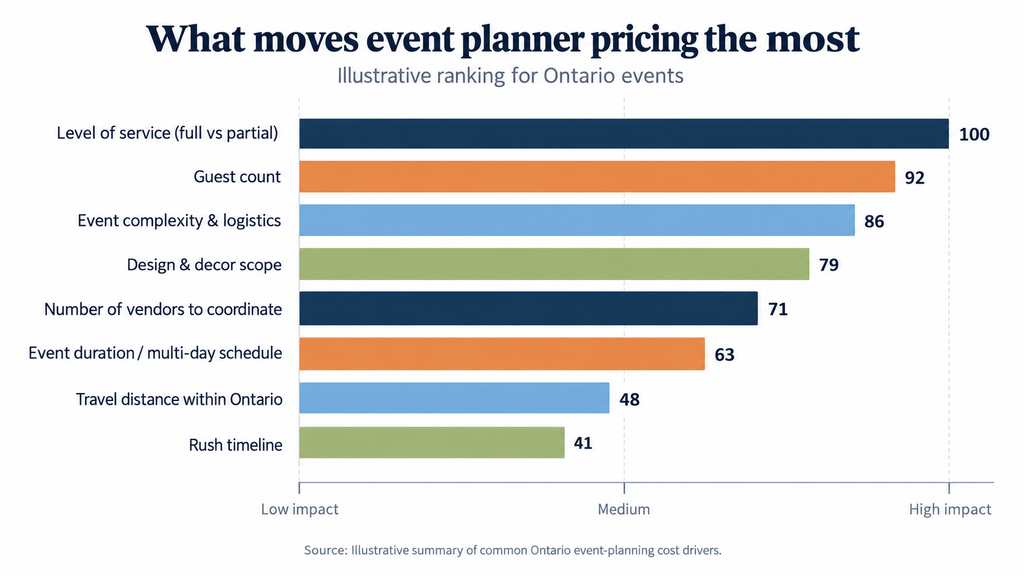
The biggest cost drivers are guest count, event duration, number of locations, planning scope, production requirements and how much transportation the event needs.
Factors That Raise the Price
More guests. A larger guest list creates more invitations, seating, catering coordination, registration work, transportation requirements and on-site staffing.
More locations. Moving people between hotels, ceremony spaces, reception venues and after-parties adds both planning hours and transportation mileage.
Longer event days. A planner may need staff on site from setup through teardown. Transportation providers can also charge for longer vehicle retention.
Complex production. Corporate events with staging, lighting, AV, livestreaming or branded environments usually require more vendor coordination. Current Toronto corporate event guides place production and AV among the largest variable budget categories.
Peak dates. Weddings, holidays, proms and major event weekends can reduce vehicle and venue availability while increasing demand.
Multiple vehicles. Ten people in one SUV may be straightforward. Moving 100 guests can require several vehicles, route planning, staggered departures and a dedicated dispatch plan.
Factors That Lower It
Scope is often the easiest place to reduce an event-planning fee. Clients who already have a venue, guest list and most vendors selected may only need coordination rather than full-service planning.
Transportation costs can also fall when routes are consolidated. A single larger vehicle may be more efficient than several smaller cars, particularly when guests share the same pickup and destination.
Off-peak dates and longer bookings can also produce better value. The important comparison is not simply the hourly price, but the complete cost of moving the required number of people safely and on schedule.
How Ontario Pricing Compares Nationally
Ontario sits within a broad Canadian event market, but Toronto can command higher rates because of venue demand, corporate activity, production complexity and supplier costs. Current Toronto planning listings demonstrate a wide spread rather than one fixed market price.
| Cost area | Ontario/Toronto planning benchmark | What changes it |
|---|---|---|
| Event planner | About 10–20% for percentage-based planning | Scope, budget and event complexity |
| Event transportation | About 5–10% as a planning allocation | Group size, distance, vehicles and duration |
The percentages should be treated as starting points, not rules. A 5% transportation allocation may work for a local dinner where most guests drive themselves. A destination wedding or corporate retreat with hotel transfers can require considerably more.
What You Get for the Money at Limo Rentals
Transportation becomes easier to budget when the provider gives the planner a clear operational picture. Limo Rentals offers event and wedding transportation across Toronto and the GTA, with vehicles ranging from sedans and SUVs to stretch limousines and buses. Its wedding service describes packages covering ceremony transfers, full-day transportation, ceremony-to-reception movements and custom timelines.
The company’s published fleet includes vehicles such as the Chevrolet Suburban, GMC Yukon XL, Lincoln MKZ, Lincoln Town Stretch, Stretch MKT, Ford Expedition, Hummer H2 Stretch and party bus.
Included as Standard
What is included depends on the vehicle and package, so the written quote matters. Limo Rentals describes professional chauffeurs, maintained vehicles and transportation tailored to group size and occasion. Its wedding packages can also cover multiple stops and dedicated transportation across the event timeline.
For planners, the practical question is whether the transport provider can confirm the vehicle, pickup sequence, service window and any additional requirements before the event. Those details belong in the master event schedule, not in a last-minute phone call on the day.
Optional Add-Ons and What They Cost
Add-ons vary by vehicle and event. Possible extras can include additional service hours, extra stops, specialty vehicles, custom décor, meet-and-greet arrangements or additional transportation units.
Do not assume that a quoted hourly rate covers every requirement. Current Toronto limo pricing sources note that HST, gratuity and optional fees can sit outside the headline rate, while special-event minimums may also apply.
How to Compare Quotes Without Getting Caught Out
A useful event transportation quote should allow a planner to calculate the real cost before the contract is signed. Compare the complete service window, number of vehicles, passenger capacity, pickup locations and total taxes and fees.
Also compare the operational plan. The cheapest vehicle is not necessarily the lowest-cost solution if it forces additional vehicles, longer transfer times or complex routing.
Questions to Ask Before You Book
- What exactly is the service window? Confirm the first pickup, final drop-off and whether the vehicle remains dedicated between movements.
- How many passengers can the vehicle realistically carry? Published capacity and comfortable event capacity are not always the same once passengers bring bags, formalwear or equipment.
- What is included in the quoted price? Ask about the chauffeur, fuel, HST, gratuity, parking, tolls, waiting time and extra stops.
- What happens if the schedule runs late? Know the overtime rate and how extensions are authorized.
- How many vehicles do we actually need? Ask the provider to review the passenger count and itinerary rather than selecting vehicles by guesswork.
- When is the final passenger manifest due? The earlier the operator receives confirmed numbers and addresses, the easier it is to build a workable transport schedule.
For airport-bound guests or delegates arriving on different flights, Pearson airport limo service can handle staggered arrivals with flight tracking built in, so the transportation schedule adjusts automatically rather than leaving groups stranded at arrivals.
Red Flags in a Quote
A quote with no vehicle specified is a warning sign because capacity cannot be verified. A quote that gives an hourly rate but hides the minimum booking period can also distort the apparent price.
Another red flag is unclear overtime. Events rarely run perfectly to schedule, so planners should know exactly what happens if the reception ends 30 minutes late.
Finally, avoid quotes that provide no breakdown of taxes, gratuity or additional charges. Transparency matters more than a low headline number.
Frequently Asked Questions
How much does an event planner charge in Ontario?
An event planner in Ontario may charge a flat fee, an hourly rate or a percentage of the event budget. A common percentage benchmark is around 10–20%, while current Toronto listings show planning packages ranging from roughly C$1,500 for smaller coordination services to more than C$10,000 for larger scopes.
What percentage of an event budget should go to transportation?
A practical starting point is about 5–10% for transportation, but the correct figure depends on the event. A local event where guests arrange their own travel may need very little. A wedding, retreat or corporate event involving hotel shuttles and multiple venues may need substantially more.
How much does event transportation cost in Toronto?
Toronto limo and event transportation pricing varies by vehicle and service duration. Current market guides put many luxury sedans around C$80–C$140 per hour, SUVs around C$110–C$250 and stretch limousines around C$150–C$300, with larger vehicles and party buses costing more. Taxes, gratuity and minimum hours can change the final total.
Is transportation cheaper when an event planner books it?
It can be, but not automatically. A planner may reduce costs by consolidating routes, coordinating vehicle use and avoiding unnecessary idle time. The bigger benefit is usually better planning: the correct number of vehicles, realistic transfer times and fewer last-minute changes can prevent transportation from becoming an uncontrolled event expense.
About Limo Rentals
Limo Rentals provides chauffeured transportation across Toronto, Mississauga and the wider GTA, with services covering weddings, corporate travel, airport transfers, special events and group transportation. Its published fleet spans sedans, SUVs, stretch limousines and party buses, allowing planners to match the vehicle to the event rather than force every guest movement into the same format.
The company also publishes wedding transportation packages that can cover ceremony transfers, reception transportation, multiple stops and custom timelines. That makes the service relevant to planners who need transportation treated as part of the event schedule rather than a standalone ride.
Service Area
Limo Rentals serves Toronto and surrounding GTA communities including Mississauga, Brampton, Vaughan, Markham, North York, Scarborough, Etobicoke, Oakville and Richmond Hill. Its service model covers both local event movements and longer GTA transportation requirements. See areas we serve for the full list.
Next Step
Build transportation into the event budget at the same time as the venue, catering and production costs. Start with the guest count, pickup points, destinations and service window, then select the right vehicle mix and request a complete quote. That gives the planner a transportation figure that can actually be managed.