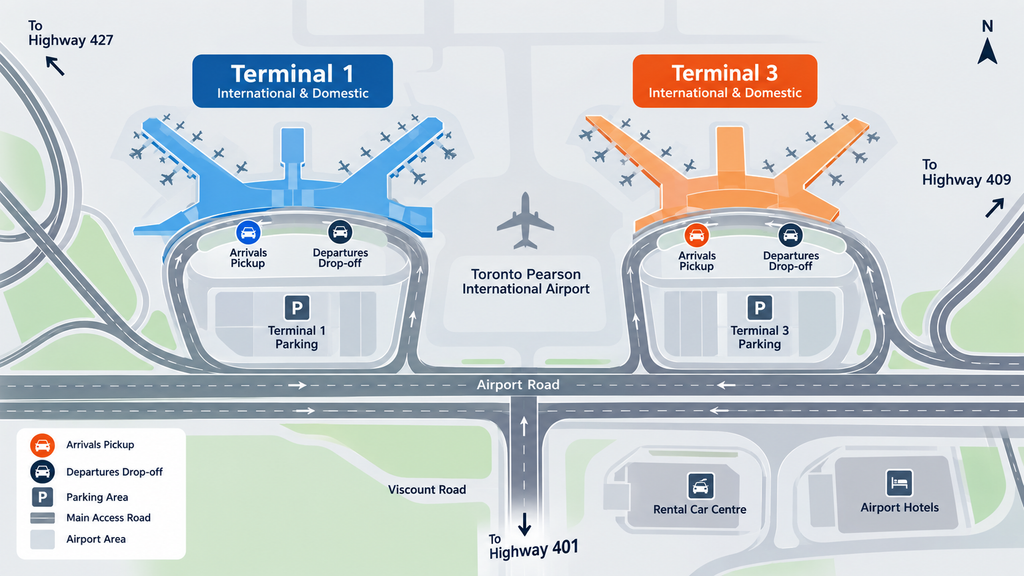
Toronto Pearson International Airport has exactly two passenger terminals, Terminal 1 and Terminal 3, and your airline determines which one you’ll use. This guide from Limo Rentals in Ontario breaks down which airlines use which terminal, how to move between them, and what business travelers, families, and connecting passengers need to know before arriving.
Key Takeaways
- Toronto Pearson International Airport operates two active passenger terminals.
- Air Canada and Star Alliance flights depart from Terminal 1.
- Porter Airlines and WestJet primarily operate from Terminal 3.
- The free Terminal Link train connects both terminals in 4 to 8 minutes.
- The two terminals are not connected airside, only landside by train.
Quick Reference: Which Airlines Use Which Terminal
| Terminal | Primary Airlines | Flight Types |
|---|---|---|
| Terminal 1 | Air Canada, Star Alliance partners, Emirates | Domestic, transborder, international |
| Terminal 3 | Porter Airlines, WestJet, SkyTeam, Oneworld carriers | Domestic, transborder, international |
Both terminals handle domestic, transborder, and international flights, so terminal choice comes down to airline, not flight type. Check your boarding pass or airline confirmation for the terminal number before you leave, since Toronto Pearson International Airport doesn’t assign terminals by destination.
Where to Go, Point by Point
Your gate letter and airline are the fastest way to confirm your terminal. Here’s what each one looks like on arrival.
Location One: Terminal 1
Terminal 1 is Pearson’s larger terminal by passenger capacity. Air Canada operates its full domestic and international network from here, alongside Star Alliance partners such as United, Lufthansa, and other members flying into Toronto. The terminal features duty-free shopping and a wide variety of dining options, along with a dedicated customs area for U.S. preclearance, letting travelers clear U.S. customs before departure rather than on arrival at their final destination.
Passengers flying internationally out of Terminal 1 should also expect longer walks between check-in and their gate, since the terminal’s layout spreads across multiple concourses connected by moving walkways. Security screening lines vary by time of day, with the busiest periods typically falling in the early morning and late afternoon as domestic and international departures overlap.
Pickup and Drop-off Zone
Terminal 1 arrivals-level pickup runs along the curb directly outside the baggage claim exits, with clearly marked zones for taxis, private vehicles, and pre-arranged pickups.
Timing
Plan for 5 to 10 minutes from baggage claim to curbside on a normal day, longer during peak arrival banks in the early evening.
Where Drivers Actually Wait
Pre-arranged chauffeurs typically wait just past the terminal doors near the arrivals-level pillars, holding a name sign rather than parking curbside, since curbside stops are limited to loading and unloading only.
Location Two: Terminal 3
Terminal 3 features a more compact and linear layout than Terminal 1, built around a central shopping and dining plaza that sits between the check-in area and the security checkpoints. Terminal 3 serves WestJet, Porter Airlines, and partner carriers from the SkyTeam and Oneworld alliances, including Delta, KLM, and American Airlines, across domestic, transborder, and international routes.
Because Terminal 3’s layout is more linear, walking distances from check-in to most gates tend to run shorter than in Terminal 1, which some frequent travelers consider an advantage for tighter connections within the same building. Pickup at Terminal 3 works the same way as Terminal 1: curbside zones directly outside arrivals, with pre-arranged vehicles typically staged just inside the terminal doors during peak arrival periods.
Location Three: Between the Terminals
If your connection involves both terminals, plan on using the Terminal Link train. The Terminal Link train connects Terminal 1 and Terminal 3, running as a free, automated service around the clock. The two terminals are not connected post-security, so any transfer between them means leaving the secure area, claiming checked bags if applicable, riding the train, and clearing security again at the other terminal.
How Early to Leave
| Departure Type | Recommended Arrival Before Departure |
|---|---|
| Domestic flight, no checked bags | 90 minutes |
| Domestic flight, with checked bags | 2 hours |
| Transborder (U.S.) flight | 2.5 to 3 hours |
| International flight | 3 hours |
These windows assume you already know your terminal. Add extra time if you’re arriving during morning or early evening peak periods, when security lines at both terminals run longer than the airport’s posted averages.
Common Mistakes
Assuming both terminals are the same building. Terminal 1 and Terminal 3 are separate structures with no walking connection. If you park or get dropped off at the wrong one, plan on a Terminal Link ride plus new security screening. Always confirm your terminal before you travel, not after you arrive.
Booking a connecting flight without checking terminals. A connection between Air Canada and a Terminal 3 carrier means leaving security, which takes longer than airlines assume in short layovers. Build in at least 75 to 90 extra minutes for any cross-terminal connection.
Ignoring the UP Express terminal stop. The Union Pearson Express only stops at Terminal 1, running every 15 minutes with a 25-minute trip to Union Station. Flying out of Terminal 3? You’ll need to ride the Terminal Link train one stop after getting off the UP Express. Factor this into your total travel time from downtown.
Underestimating parking distance. Both terminals have their own parking structures, along with additional car rental and long-term lots connected by the Terminal Link. Confirm which garage matches your terminal before you park, since walking between the wrong garage and your gate can add significant time.
How Limo Rentals Handles It
Limo Rentals confirms your exact terminal at booking, using your flight number rather than a general airport address. This means your driver already knows whether to meet you at Terminal 1 or Terminal 3 before your flight even lands.
Flight tracking is built into the service, so pickup timing adjusts automatically if your flight lands early or late. Drivers meet arriving passengers at the terminal’s designated arrivals-level pickup zone, with a documented wait policy that accounts for customs delays on international arrivals. For departures, chauffeurs confirm terminal and check-in details in advance, so there’s no guessing at the curb about which building your airline uses.
Booking ahead also means confirming ground transportation before you’re standing in an unfamiliar terminal comparing taxi lines to rideshare apps. Whether your flight is with Air Canada out of Terminal 1 or Porter Airlines and WestJet out of Terminal 3, the pickup process works the same way on the Limo Rentals side.
What to Have Ready at Either Terminal
Both terminals require the same basic documents for check-in and security: government-issued photo ID or a passport for international travel, your boarding pass, and any visa or entry documents required at your destination. Arriving international passengers should also have their customs declaration ready, since both terminals route arriving international flights through the same federal inspection process before travelers reach the arrivals level.
Both terminals also offer free high-speed Wi-Fi and full accessibility services, including wheelchair assistance and dedicated lanes through security.
Travelers open to nearby airports as an alternative should note that Billy Bishop Toronto City Airport and John C. Munro Hamilton International Airport both serve select domestic and U.S. routes, though neither carries anywhere close to the flight volume of Toronto Pearson International Airport. For most itineraries connecting through Ontario, Pearson remains the primary hub, and confirming your terminal in advance still matters more than which airport you’re flying from.
Pearson also continues to run construction and expansion work across both terminal areas as part of its long-term modernization plans, so travelers should follow posted signage closely, since gate and pickup locations can shift temporarily during active construction phases.
Frequently Asked Questions
How many terminals does Toronto Pearson International Airport have?
Toronto Pearson International Airport has two active passenger terminals, Terminal 1 and Terminal 3. There is no operational Terminal 2, so if you see it referenced in an older guide or map, it’s outdated information. Your airline and specific flight number determine which terminal your flight uses, not your destination city or country.
What terminal does Air Canada use at Pearson?
Air Canada operates its domestic, transborder, and international flights from Terminal 1, along with its Star Alliance partners. Terminal 1 also includes a dedicated U.S. preclearance area, letting Air Canada passengers headed to the United States clear customs before departure instead of after landing at their destination.
What terminal does Porter Airlines use at Pearson?
Porter Airlines and WestJet both operate from Terminal 3 at Toronto Pearson International Airport, along with SkyTeam and Oneworld partners. Passengers connecting from a Terminal 1 flight to a Porter Airlines or WestJet departure will need to use the Terminal Link train and clear security again at Terminal 3.
Can I walk between Terminal 1 and Terminal 3?
No, there is no walking route between the two buildings, and they are not connected airside or post-security. The free Terminal Link train is the only way to move between Terminal 1 and Terminal 3, running 24 hours a day with a ride time of 4 to 8 minutes between stations.
Pearson Terminal 1 vs 3: how do I know which one my flight uses?
Check your boarding pass, airline app, or booking confirmation, since these always list a terminal number. Toronto Pearson International Airport assigns terminals by airline rather than destination, so the same route can depart from either building depending on which carrier operates it.
About Limo Rentals
Limo Rentals provides ground transportation to and from Toronto Pearson International Airport, with service across Toronto, Mississauga, and the surrounding Greater Toronto Airports Authority service region. Vehicles are professionally driven, with drivers trained to confirm terminal assignments at booking so pickups and drop-offs go to the correct building on the first try, rather than guessing based on a general airport address.
This matters most for connecting travelers and families managing luggage across a terminal change, where a driver who already knows the site layout can save real time compared to arriving without a plan. Limo Rentals also coordinates directly with passengers via contact details provided at booking, so any flight changes affecting terminal or timing reach the driver well before pickup.
Service Area
Limo Rentals serves Toronto, Mississauga, and municipalities across the Greater Toronto Area, with direct pickup and drop-off available at both Pearson terminals as well as nearby airports on request.
Next Step
Ready to book your airport ride? Reserve Toronto airport limo service with Limo Rentals, and confirm your Pearson terminal in advance so your driver knows exactly where to meet you.
Related reading: For travelers connecting through Toronto from outside the city, see our guide on Aurora to Pearson Airport limo service, and for public transit riders, our post on bus service to Toronto Pearson Airport covers routes and timing in more detail. Travelers comparing costs can also check our breakdown of Pearson airport limo flat rate pricing. See areas we serve for pickup locations across the region.